
This is a republishing of the Metaphysics of Physics podcast interview with physicist Bill Gaede, originator of the Rope Hypothesis. We talk about the Rope Hypothesis and some of the problems he has with modern physics.
For those unaware, the Metaphysics of Physics was the previous incarnation of this site and for a time in included a podcast.
You can read the transcript or use the audio player below to listen to the interview. Or do both if you prefer!
Click here to download the episode.
Introduction
Today we have an interview with the physicist Bill Gaede, originator of the Rope Hypothesis. We have not presented the transcript of this in web page form. Instead, you can listen to the audio or download the PDF transcript.
You can find out more about Bill Gaede’s idea on his YouTube page. Check out his Quora profile to see him answering some physics questions.
You may have problems with the audio if you hit the play button above after jumping part of the way into the audio. We are not sure what this issue is or how to fix it. You can download the episode or simply play it from the beginning.
Gaede and I discuss the problems in modern physics, some of the many ways in which physics is irrational, the improper conflation of mathematics with physics, his rope model and more.
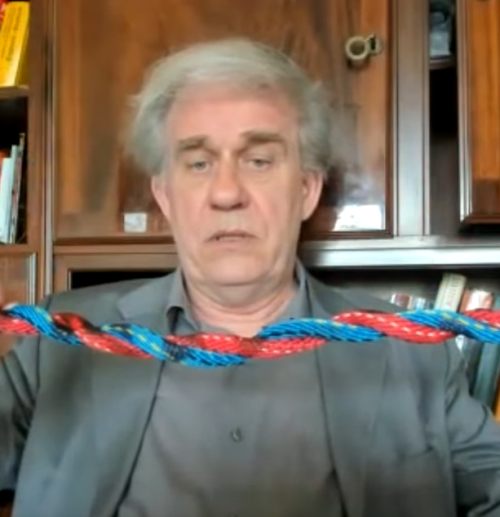
The problems he mentions are largely centered around the idea that we do not have physicists anymore, we have mathematicians. People that try to describe but not explain how this universe works. But, physics is meant to be about explaining how the universe works!
This is where the rope model comes in. It offers an explanation of light, electromagnetism, gravity and more. Gaede discusses this in some depth in his book “Why God Does Not Exist”.
Episode Transcript
Please note that the transcript has been edited for grammatical purposes. The contents accurately represent the material, however changes have been made to make it easier to read. So, it will not exactly match the audio.
However, there may be mistakes in the transcript. Any mistakes in transcription represent our own errors or a transcription error we missed.
Click here to download the PDF transcript.
Excerpt
Dwayne: Okay, we’ll start with the first and most obvious question, what is physics? You have talked about the Golden Principle of physics. Tell us about that as well.
Gaede: Yeah, well, the Golden Principle.
First, physics is not the study of this or the study of that. Anybody can study and not be able to explain anything in science, let alone physics. But science is not just the study of something. It’s explaining something, especially as regards to physics. You must explain physical mechanisms, causes. That’s what I think physics is about.
In order to explain causes, you need to have objects. And I think the bread and butter of physics is this word called object. And to me, it’s stunning that no one has figured this out in mathematical physics.
Since the days of Newton, at least, no one has figured out that you need an object to do physics. Once you cover that stuff, you got to define the word object. And no one has defined the word object in a scientific way.
Not a single physics textbook on planet Earth begins by saying: “This is an object and this is what we’re going to do with it”.
In other words, specifically defined keywords that you need for the foundations of physics. This is an object, this is distance, this is a location. This is what we mean by motion. These words have never been defined in a scientific way.
In fact, Newton said he didn’t know what motion was. And so, yes, I think physics is the study of causes and mechanism. It’s not about math, it’s not about measuring and it’s not about equations.
It’s about explaining a mechanism. You want to explain how a magnet works; you want to explain how gravity works.
In order to do that, you need objects and you need to define what an object is. So, in a nutshell, is my vision of physics.
Dwayne: Okay, so how would you define an object?
Gaede: Well, you know, if you look in the dictionary, you’ll find definitions of ordinary speech, not scientific definitions. In other words, not ones that you can use consistently, rationally.In order to use that word consistently, scientifically, rationally, you have to define it as that which has shape. That’s the only property all objects have, whether imaginary objects or real objects. All of them have the
same property, shape.
And what doesn’t have shape as known as a concept, essentially.
Dwayne: Right, I agree. What is mathematics? And how does it relate to physical objects? For instance, how do numbers relate to physical objects?
Gaede: I love the question. No, I’m saying mathematics has nothing to do with physics or with science. And people immediately say: “Why? No, you’re crazy. What do you mean, mathematics has nothing to do with science?”
We go back to the definitions and just follow them strictly. What is science about? What is physics about? Physics is about explaining phenomena, causes and mechanisms. We have no use for mathematics whatsoever.
So, in that sense, mathematics has absolutely nothing to do with physics or with science. If physics is about explaining causes and mechanisms
Obviously, if you define physics as measurement, equations, predictions, observation, proof evidence, well, then yeah, then you can bring mathematics in.
What’s happened is that the mathematicians have defined what science, what physics is, not the physicists. And a real genuine physicist defines physics a little differently than a mathematician. He views it as causes and mechanisms. For that, we have no use whatsoever for mathematics.
What does an equation do? Equations are just a description. And I’m not asking for a description. I’m asking for an explanation.
And for that, you need to define the words “explain” and “describe” and find out what the difference between those two words is. But a lot of people think they’re synonyms.
Dwayne: Okay, so how would you describe these words and the difference between them?
Gaede: Well, a description is a listing of properties. Say that I want to describe a chair. I say it’s got four legs, it’s brown, it’s big, it’s small. I use adjectives and I qualify it. All I’m doing is describing. I haven’t explained anything so far.
An explanation is revealing causes and mechanisms for phenomena. And saying that there was something which happened. You are going to say how it happened.
Meaning, not a description like “It fell down and it fell at 9.8 meters per second squared”.
No, that’s not an explanation. You want to know what caused it to fall down and not up, for example. Or how does one magnet attract another?
I can’t just say, well, it attracts at such and such speed at such and such distance. That’s not an explanation. That’s just the description.
What I want is an experience. I want to know the mechanism. If I want to explain to you the mechanism, then I can use the following example, because I guess everybody can relate to it.
You have a pulley and you have a bucket. You have a rope tied to the bucket and the rope goes around the pulley, the little wheel. And you say well, how did he put the bucket up there? It was full of water, and how do you put the butter bucket up there?
I show the movie and I don’t even have to explain anything. I can just show the movie. All the objects are all visible. And you see this guy pulls on the rope, the rope goes around the pulley, the wheel turns and the bucket goes up.
So, everybody looks at that and they say, I understand how the bucket ended up there, he just pulled down on the rope.
And that is a mechanism everybody can understand. Because everything is visible in front of your very own eyes. And so, all you have to do is watch the movie and say, “I understand the mechanism”.
But we don’t do that with magnets. We don’t do that with gravity, we don’t do that with light or with atomic behavior. We don’t do that with electricity.
What we say there oh, let me describe it for you. And in the case of gravity, they say mass. And mass is a concept, it is a mathematical concept. I can’t say mass did this or mass did that. It is like saying the weight of an elephant did this. The weight of an elephant squashed the ant.
No, it was the foot of the elephant that squashed the ant, not the weight. Weight has no power to do anything. Weight is a mathematical concept.
Likewise, mass is a mathematical concept. And you can’t say energy did this or that either, because that’s another mathematical concept.
The problem we have today is that we use these words like field, force and time. But nobody has defined these terms, which are obvious concepts.
And they use them as if they were physical objects. They tell you that time has warped. And they tell you that they sent energy, that they transferred energy. They say that they moved the mass. That the force
was strong, it was a very strong force. And so forth.
And so, we’re using all these concepts as physical objects. We have gotten so used to it because they’re all mathematical concepts. And its mathematicians who have defined science, not physicists.
In fact, if you go back to square one, we go back to Aristotle, he’s the guy who wrote the first book of physics that we have today. The first extant book of physics. That’s his eponymous book known as “Physics”.
Aristotle says, look, mathematicians do angles, numbers, that’s mathematicians. Physicists, they do causes.
And a lot of people criticize this and they say “Well, Bill, you want to go back to the days of Aristotle”.
But you must understand the context. The context is not that we want to go back to Aristotle in the sense that maybe his scientific method was to be desired. The issue is that he had the right idea, physics explains causes. That’s what we forgot.
There’s nothing wrong with people doing experiments. There’s nothing wrong with people doing math if they want. But when they come to the conference, they have to explain the mechanism. And that’s what they forgot about.
They do a lot of math, they have a lot of descriptions, equations, numbers., they talk about infinity. They bring in all these fancy words like energy and field. And what we’re missing is the explanation of the mechanism.We still don’t know how one magnet attracts another. Or how gravity works. And this is the issue.
That’s why I go back to Aristotle only in the context of that business about causes and mechanisms.

